bryophytes of pine barrens, cedar glades, and similar habitats in east texas
Catahoula Barrens
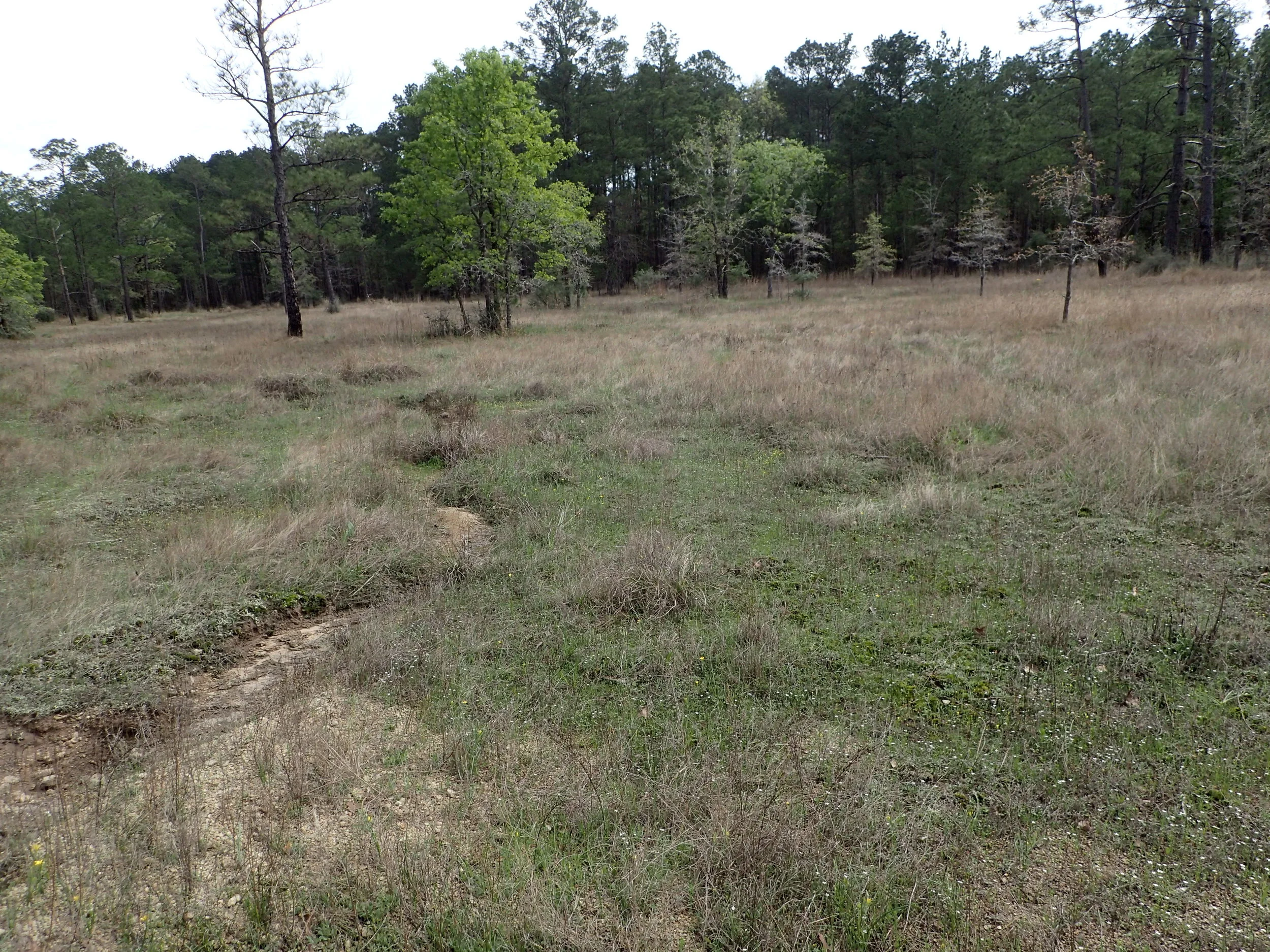
Vegetation associated with thin soils over the tuffaceous sandstone of the Catahoula Formation is primarily herbaceous. But where the soil is deeper, or fire is excluded for long periods, it can display significant woody cover, with usually stunted representatives of species such as Pinus palustris (longleaf pine), Pinus taeda (loblolly pine), Pinus echinata (shortleaf pine), Quercus stellata (post oak), Quercus marilandica (blackjack oak), and Carya texana (black hickory) dominating the canopy. Shrubs may form a patchy, discontinuous layer with species such as Ilex vomitoria (yaupon), Morella cerifera (wax-myrtle), Vaccinium arboreum (farkleberry), Forestiera ligustrina (elbowbush), Gelsemium sempervirens (Carolina jessamine), and Crataegus spp. (hawthorns) commonly encountered. Maintenance of fire in the landscape will reduce woody cover in these sites, with herbaceous dominated sites displaying increased species richness. On open sites, there may be exposed patches of bedrock or mineral soils, or areas of patchy cover of foliose and/or fruticose lichens.
Weches Formation
Vegetation restricted to outcrops of the Weches Formation in San Augustine, Sabine, and Nacogdoches counties, where it occupies generally shallow soils that oscillate between very dry and saturated (during winter and early spring). These are small patch occurrences and are therefore difficult to map using our methodology. Edaphic constraints tend to restrict the growth of woody species, though as soil depth increases, so does woody plant development. Outcrops may be exposed as a result of natural erosion on slopes or may be a result of human-induced openings.